Limited feedback after rejections
Most candidates receive generic rejection notes without detail on pacing, depth, or communication gaps that influenced the decision.
Loading
AI-powered career platform
AI mock interviews, recruiter-style feedback, coding practice, job alerts, and a job tracker - everything you need to land your next opportunity.
More offers. Better salary. It starts with the interview. Find out what a recruiter would flag in your answers - before your real interview does.
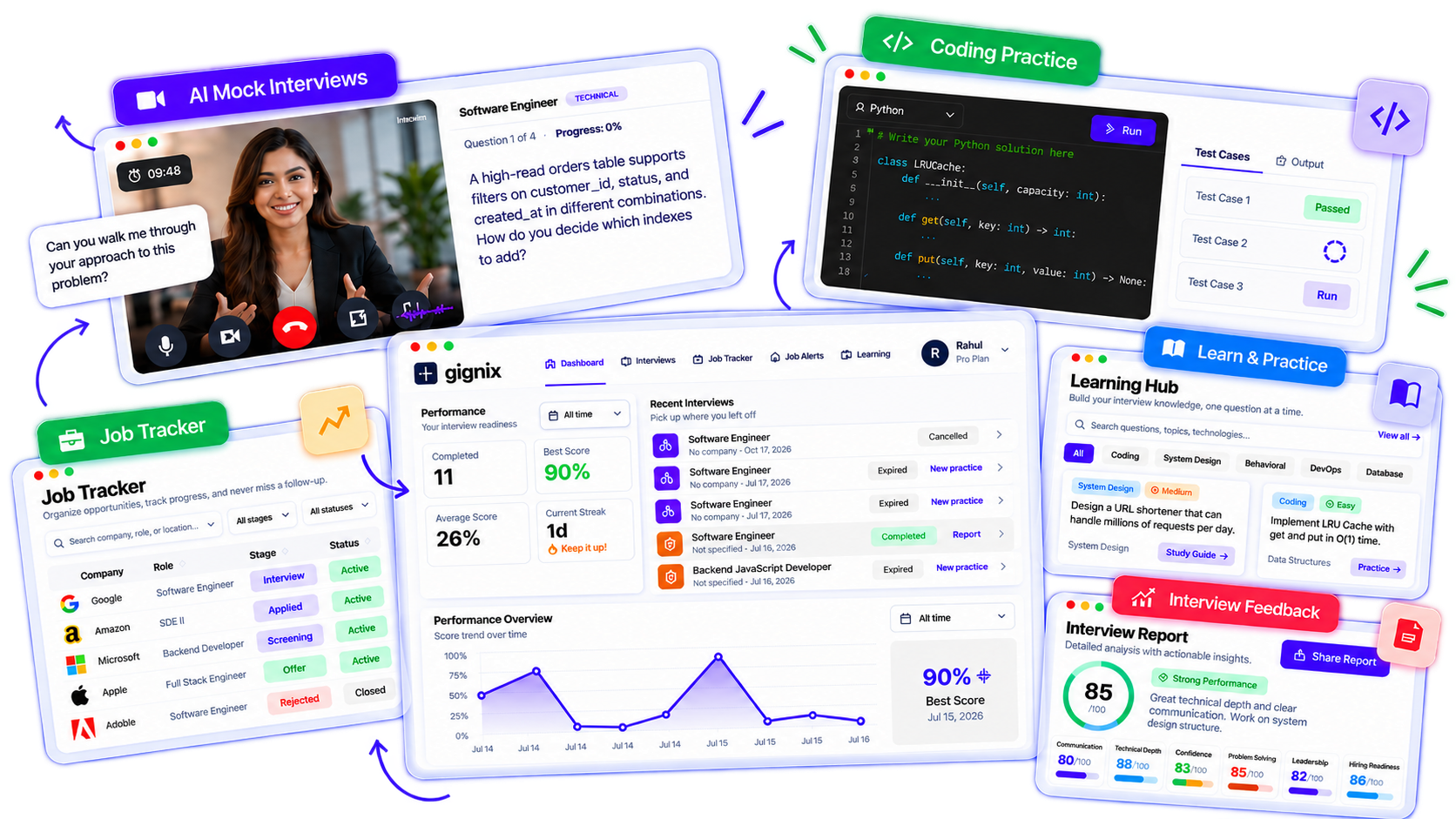
Interview loops rarely return specific feedback in time to fix the signals that mattered.
Most candidates receive generic rejection notes without detail on pacing, depth, or communication gaps that influenced the decision.
Answers may miss trade-off reasoning, scalability context, or ownership framing—dimensions interviewers track in technical and system design rounds.
A correct answer delivered without clear structure can read as junior-level. Sequencing and framing matter in how recruiters interpret responses.
The same answer can score differently depending on depth, structure, and delivery. Gignix highlights those gaps in your feedback report.
“I'd use a message queue to handle async processing—probably Kafka or SQSdepending on scale.”
Missing trade-off discussion“The database layer would be sharded based on user IDto distribute load.”
“For caching I'd use Redis to reduce read pressure on the primary database.”
“I thinkthat covers the main components of the system...”
Hedging languageMissing scalability reasoning
Affects depth scoreNo mention of throughput targets, SLA requirements, or system behavior under failure at scale.
Weak prioritization framework
Affects technical scoreComponents were listed without justifying tradeoffs or cost-performance balance decisions.
Limited ownership signals
Affects hiring perceptionHedging language ("I think", "probably") reduces perceived confidence and delivery capability.
“Gignix reveals the hidden signals that influence hiring decisions.”
Personalized Feedback
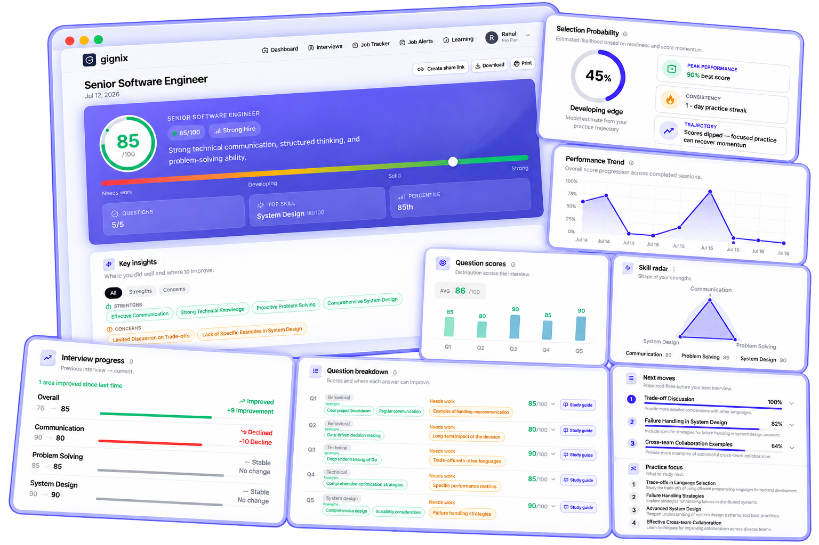
Every session ends with a structured report on the answer, the signals behind it, and what to change next.
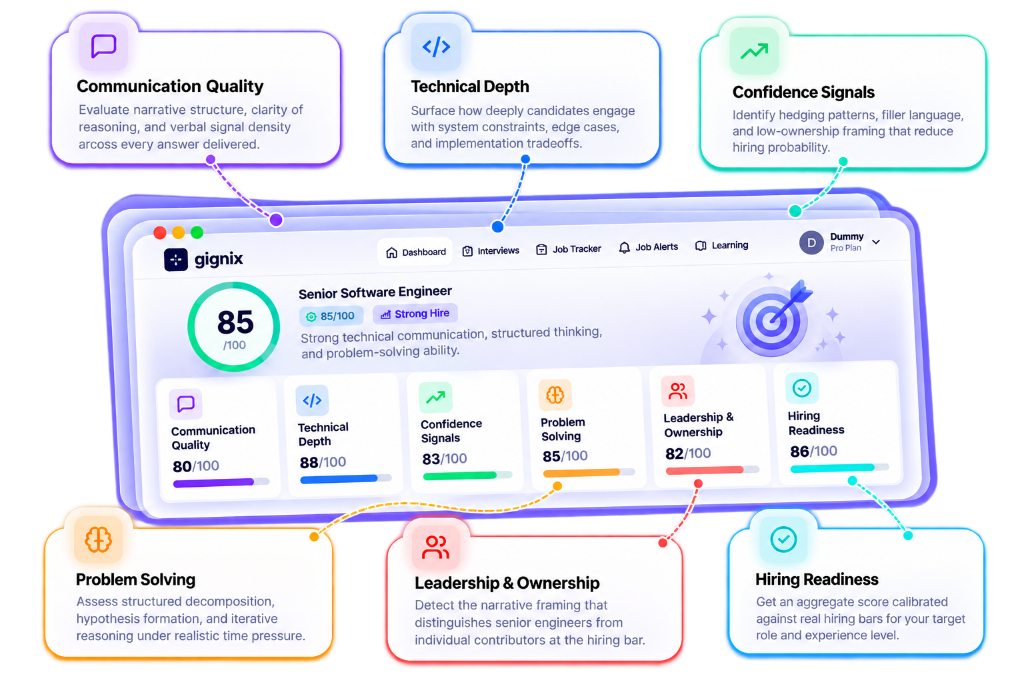
Six core dimensions scored against role-specific hiring bars.
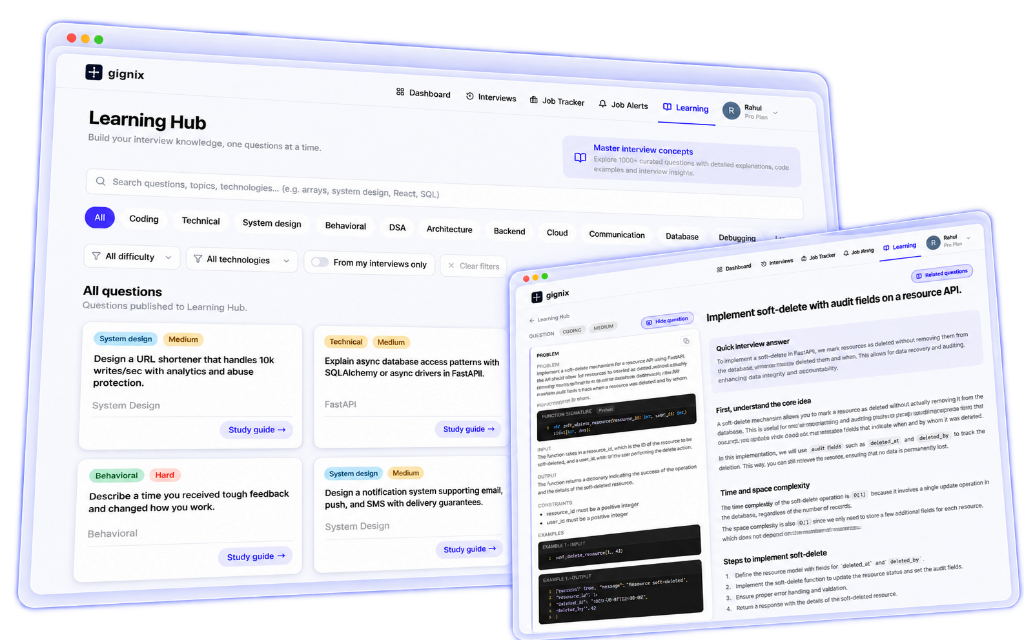
Browse coding, system design, and behavioral questions, then study the explanation, the code, and the points worth saying out loud.
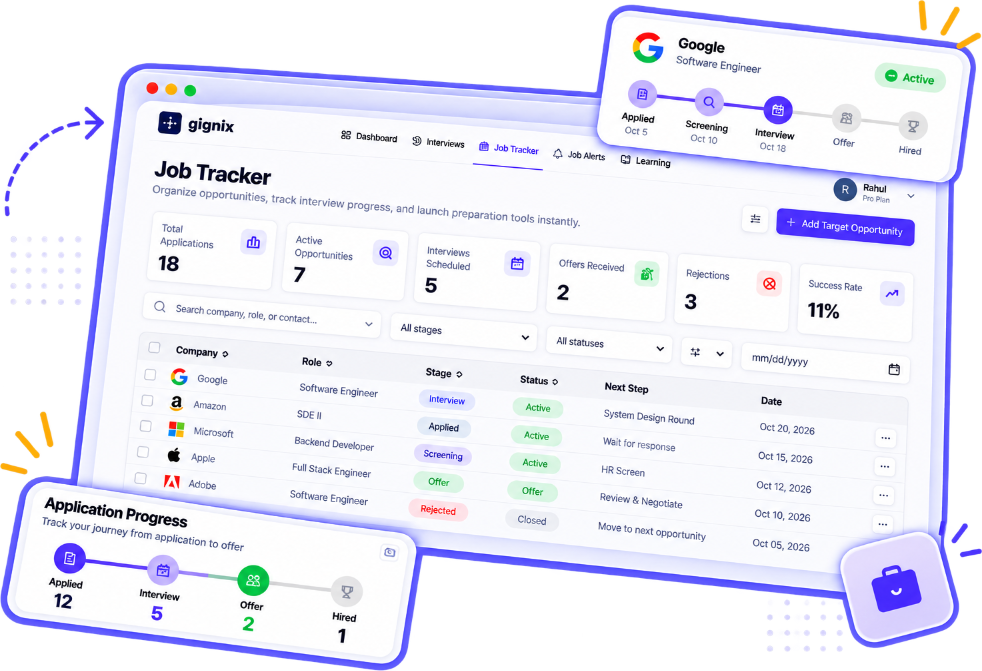
Organize companies, roles, and interview stages while you prepare, and see which applications are moving.
FAQ
Answers about mock interviews, job tracking, pricing, and how Gignix works.
Gignix helps software engineers practice interviews and track job applications. Each mock interview produces feedback on technical depth, delivery, and problem-solving structure.
Yes. You can start a free mock interview from the interview page without creating an account. Sign up to save reports, use the job tracker, and access higher plan limits.
Gignix supports coding interviews, system design, behavioral rounds, and production operations scenarios. Question difficulty adjusts to your target role and seniority level.
The Job Tracker lets you log applications, interview stages, and company details in one dashboard. It helps you stay organized during an active job search and is included on all plans with tier-based limits.
Most sessions take 20 to 40 minutes depending on the module. Your feedback report is available immediately after you finish.
Yes. Role settings calibrate questions and scoring from mid-level through principal engineering interviews, including system design depth and ownership signals.
The free plan includes limited interviews and job tracking. Pro starts at $5.99 per month and Premium at $11.99 per month in the US. Yearly billing is available at a discount.
No. Your session data is used only to generate your personal reports and operate your account.
No account required. Paste a job description, get role-specific questions, and review recruiter-style feedback in under an hour.
The mock loop was the first time I heard myself skip the constraint and jump straight to a database choice. The written notes named that moment, so I rewrote the opening of my system design answer before the real screen.
Follow-up questions tracked the code I had just written. I was asked why a query sat inside the loop, which is the kind of thing a generic rubric never catches.
I keep each application in the job tracker with the stage and the next date. A take-home that used to slip now sits next to the role, so I can see what is waiting without a separate spreadsheet.
The communication notes marked pace and filler instead of handing me a score and calling it a hiring decision. I practiced the same story again and could hear the difference.
The React set asked about rendering cost and component boundaries, then the report quoted the part of my answer that stayed vague. That was enough to study from the next evening.
I did not know how a recruiter screen was supposed to sound. Reading the transcript showed me burying the result of a project under the tools I used. I led with the result the next time.